
By Coach Jen Heller
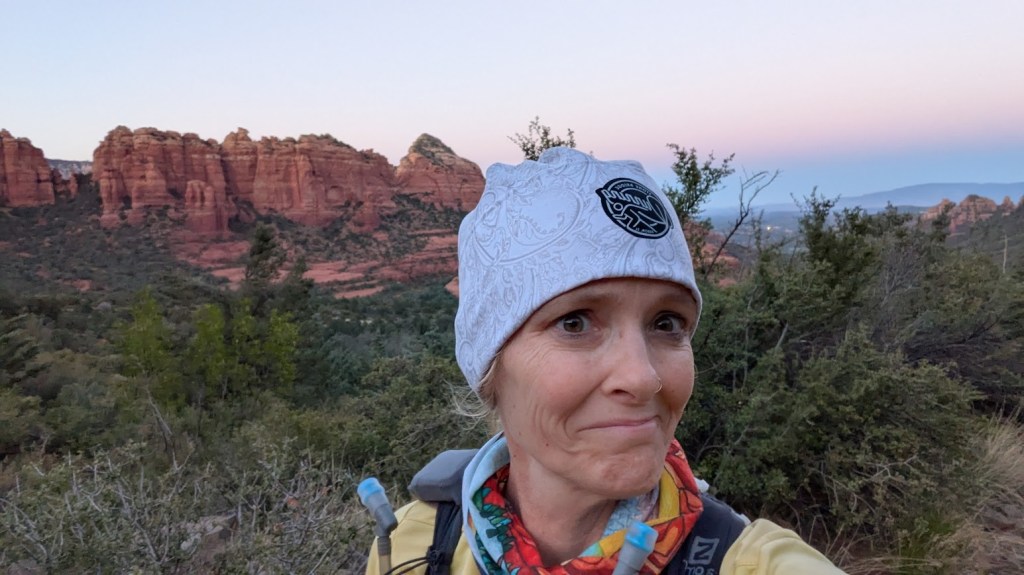
There’s a moment in every ultrarunner’s journey that’s more defining than a finish line—and it’s the moment you don’t reach one for me.
I DNF’d at Sedona 125.
That sentence still feels heavy, but not in the way people might expect. Because here’s the truth: I gave it everything I had. I wasn’t fully trained the way I had hoped. I’d been battling a hip injury leading up to the race, and that derailed a lot of my training. Most of my runs were switched to power hikes—but honestly, that turned out to be one of the best things I could’ve done for this particular event. The movement felt strong and purposeful. But I also believe that the lack of running took a toll on my lungs. My VO2 max took a dive, and I’ve felt it even now back in Illinois. As someone with asthma, the allergens here are currently making breathing feel like a bit of a challenge.
What I couldn’t train for was the altitude.
It wasn’t on my radar. Coming from Illinois, I prepared in the ways I thought mattered—mileage, strength, heat acclimation in the sauna. But altitude? I didn’t think it would be the thing to take me out. And yet, there I was, laying on the side of the trail gasping for breath, unable to keep water down, vomiting, disoriented, and at one point, hallucinating. I thought a guy who helped me down a terrifying descent was my brother.
Eventually, the medics pulled me from the race. Going to the med tent was a last-ditch effort. I had already told my crew I was done. They were hoping the medics would somehow be the push I needed to keep going. That didn’t work out—because the medics made the call. And while I want to be clear that it was their decision, I was already done. I had no energy left. I had told my crew I wanted to stop. I was beyond empty.
In the weeks since, people have asked how I’m doing. Honestly? I’m okay. This was my first big DNF, but I don’t carry regret. I carry frustration, yes—but not shame. I didn’t quit because it was hard or because I wasn’t having fun—I quit because my body had absolutely nothing left to give. I had just finished the hardest part of the course—the first 50 miles—and made it up to the plateau where the terrain would finally ease up, and I’d soon have a pacer. Shame is walking away when you still have something in the tank but don’t want to hurt. This wasn’t that. This was my body completely shutting down. I can’t fully describe the feelings I experienced out there—I’ve never felt anything like it. Laying down on the trail was the only way I could find any relief and actually breathe. I know I left it all on that trail. My legs had more to give, but my lungs did not.
One of the hardest parts was feeling like I let people down—my crew, my friends and family back home in Illinois, everyone watching and cheering. I messaged my crew afterward to say I was sorry I couldn’t give them the finish. That still sits heavy on my heart. But I’m grateful they were out there for me, even if we didn’t all agree on when enough was enough.
I’ve had time to reflect on what I learned. I’ll always take altitude into account now—even if it’s just 5,000 to 7,000 feet, it’s a thing—not just for myself, but for my athletes. Whether that means going out early to acclimate, investing in an altitude mask, or reevaluating sauna training versus true elevation exposure, I’ll be more prepared next time. I’ll push my athletes to be too.
I’ve also learned that spending long stretches alone in a race isn’t something to fear. I handled that well. And I’ll keep dialing in my nutrition, especially liquid options that are easier to carry and absorb when your body starts rejecting everything else.
So what now?
I’m feeling a bit stuck right now. Not having a goal is hard for me. I’m a goal-driven person. It keeps me grounded, focused, and feeling like I’m moving forward. Without it, I feel like I’m tied to a tree, walking in circles. That’s where I am right now—in limbo. But I’m working on it. I’ve always found my way forward, and I will again.
That’s the question swirling in my brain. I don’t know what’s next yet. I don’t think I’ll go back to Sedona—not next year, maybe not ever. It’s expensive, and I can’t ask my crew to go through all that again.
But I know I’ll chase something. Maybe something solo. Maybe something with just the hubby or just a couple close people. I don’t know where yet, but I know I’m not done.
If you’ve got a race within 200 to 300 miles driving distance from Dixon that screams, “Here’s your next challenge,” I’m listening. I’ve already put some feelers out to a few people to get their thoughts on some big, scary goals I’ve been eyeing, and we’re chatting about possibilities. So, you never know—something might spark soon.
This wasn’t a failure. It was a reckoning. And I’m proud of how I showed up for it.
As a coach, I want to say this loud and clear: don’t be afraid to do hard things. Don’t be afraid of failure. That’s where the growth is. That’s where life is. If you’re scared to go after something because you might not succeed—do it anyway. “What if I fail?” Well, what if you don’t? And even if you do—you stood at the start line. You had the courage to try. That’s braver than most ever get.
There’s a quote I love: “Only those who risk going too far can possibly find out how far they can go.” – T.S. Eliot.
Another one I keep coming back to: “Courage doesn’t always roar. Sometimes courage is the quiet voice at the end of the day saying, ‘I will try again tomorrow.’” – Mary Anne Radmacher.
Just because I didn’t cross the finish line doesn’t mean I didn’t cross into something powerful. I grew. I got stronger. I’ll be a better coach because of this. A better human. A better athlete.
Don’t let someone else’s DNF scare you away from doing hard things. Don’t let your fear of failure talk you out of signing up. Go after the big, scary thing. That’s where the good stuff is.
This race gave me more than a belt buckle ever could.
 Runners of the Corn Coaching